The Wrong Man: How a 124-Year-Old Mistake Came to Light
Or: what happened when a sharp-eyed follower looked more closely at our Alex Raisbeck card than Ogden’s ever did
Last week we listed one of the more significant Liverpool cards to pass through our hands: Alex Raisbeck on Ogden's Tabs (1900–02), the plain-backed "Similar" variant, graded PSA 4 and one of just two copies at that level with none finer. Raisbeck was Liverpool's first great captain — the man who lifted the club's first ever League Championship in 1900–01 — and a card issued at the very height of his powers seemed a straightforward thing to write about.

Then a follower on Instagram left a comment. The photograph on the card, they pointed out, isn't Alex Raisbeck at all.

They were right.


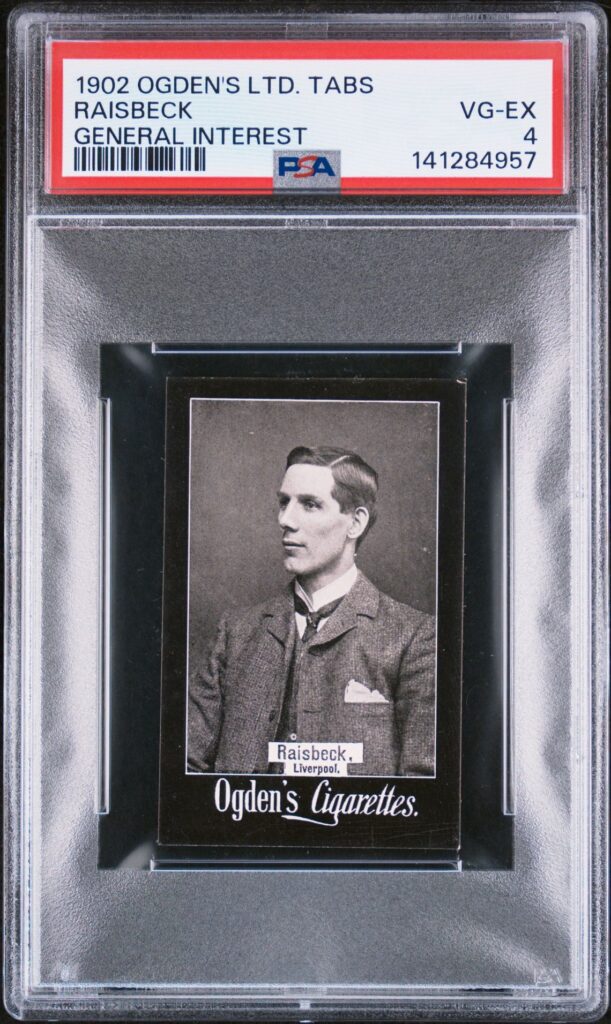
The card in question: Ogden's Tabs (1900-02), 'Similar' plain-back variant, captioned Raisbeck, Liverpool. PSA 4, joint-highest graded. But who is that in the photograph?

A face that doesn't fit

Put the card next to any verified portrait of Raisbeck and the mismatch is unmistakable. Raisbeck was a thick-set man with a famous shock of fair hair — contemporaries rarely described him without mentioning it. The man gazing out of the Ogden's card is nothing of the sort: thin-faced, dark-haired, neatly parted. Whoever he was, he never captained Liverpool.

He did, however, captain Rangers. The portrait is R.C. Hamilton — Robert Cumming Hamilton, Rangers' prolific centre-forward and captain, a Scotland international many times over, and one of the most recognisable Scottish footballers of the age. Ogden's had printed the wrong man under Raisbeck's name, and the error has sat uncorrected, and largely unremarked, for more than a century.

And we can prove what Raisbeck actually looked like using Ogden's own cards — because around the same time, they had got him exactly right.


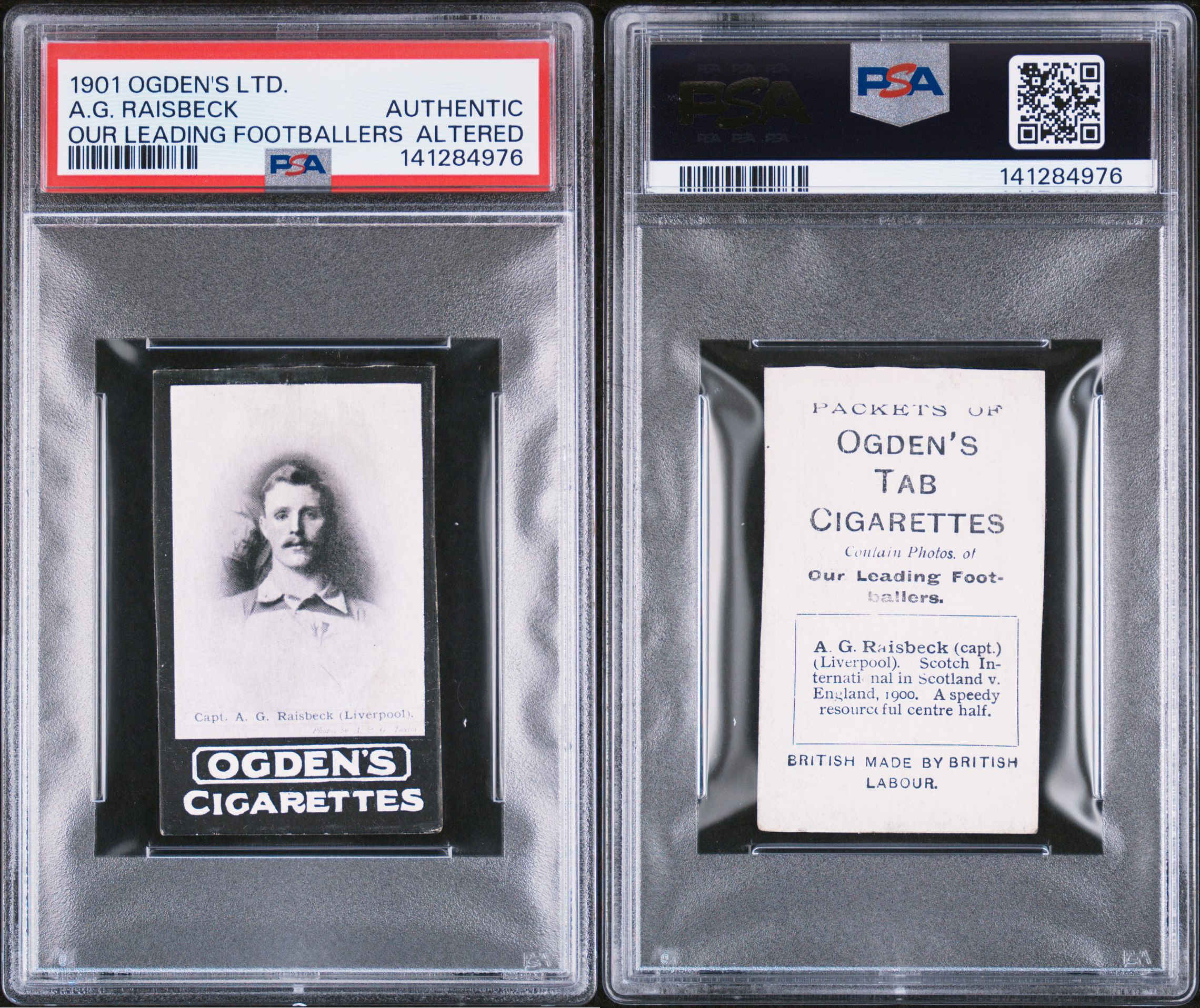
The control specimen: Ogden's 'Our Leading Footballers' (1901), correctly captioned Capt. A. G. Raisbeck (Liverpool). The real Raisbeck — thick-set, fair-haired, moustachioed — as photographed by the very firm that would shortly get him wrong.

A face that fits perfectly — under the wrong name

Ogden's 1901 "Our Leading Footballers" card shows the genuine article: correct portrait, correct spelling, correct initials — A.G., for Alexander Galloway Raisbeck — and even his captaincy acknowledged in the caption. In 1901, Ogden's demonstrably knew exactly who Alex Raisbeck was and what he looked like.

Which makes what happened in the Tabs series that followed all the more remarkable. Because the Tabs issues do contain Raisbeck's real face — on a different card, in a different series within the Tabs family, above a caption reading "A. Raisback."


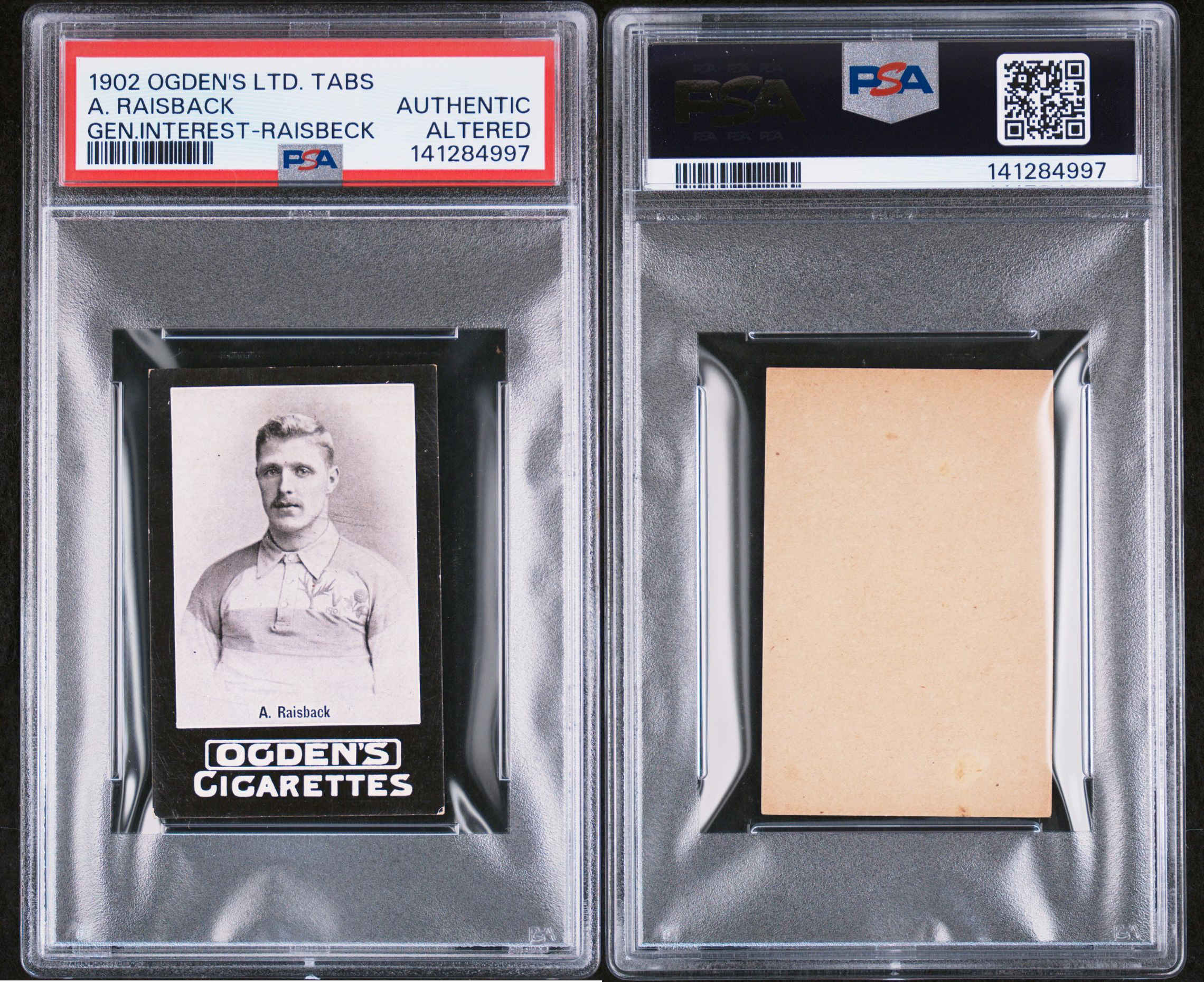
The "A. Raisback" Tabs card. Caption: "The other half of the muddle: the same Tabs era, the right man at last — Raisbeck in what appears to be a Scotland jersey — but now with his name misspelled 'Raisback'.

Take stock of that for a moment. Across the Ogden's Tabs footballer issues, Liverpool's first championship-winning captain appears twice — once with the right name and the wrong face, and once with the right face and the wrong name. At no point in the entire Tabs era did Ogden's manage to put Alex Raisbeck's own portrait above his own correctly-spelled name. A firm that had identified him perfectly in 1901 then got him wrong twice running, in opposite directions.

How does a mistake like that happen?

More easily than you might think, and this series is repeat offender territory. Beyond the Raisbeck muddle, the Ogden's Tabs footballer issues also managed to transpose the photographs of J. Robertson of Rangers and the great Billy Bassett of West Bromwich Albion — each man appearing on the other's card.

To understand why, it helps to picture how these cards were actually made. Edwardian card manufacturers did not send photographers to matches. They bought portraits — from commercial studios, from agencies, from whatever stock was available — and assembled their sets from a pool of photographs that arrived with varying degrees of labelling. Somewhere between the photograph drawer and the printing plate, a caption had to be matched to a face by someone who had quite possibly never seen either man play. Most of the time they got it right. Sometimes they didn't, and once the plates were made, the error was baked into every card that rolled off the press.

Our own records suggest how the Hamilton mix-up probably happened. Searching our database for R.C. Hamilton shows he does not appear anywhere in the "C" series that contains the error card — but he does appear, under his own name and with a different photograph, in the "D" series that followed the same year. The likeliest reconstruction: Ogden's had both men shortlisted, held photographs of both, moved Hamilton to the following series — and in the shuffle, his portrait stayed behind under Raisbeck's caption. Hamilton became the ghost of the C series: a player whose face appears but whose name does not.

A photograph with a long afterlife

The database turned up one more detail worth sharing, because it says so much about how this industry worked. The photograph Ogden's used for Hamilton's legitimate D-series card appears again — the identical portrait — on cards issued by F. & J. Smith's in 1909, and again in 1914. By that final outing the image was more than a decade old, and Hamilton himself had long since left the top flight; he would shortly leave football altogether for a distinguished second act as a schoolmaster and, eventually, Provost of Elgin. Smith's were selling schoolboys a card of a sitting town dignitary wearing his 1902 face.

That was entirely normal. Photographs were commercial assets with long working lives, licensed and re-licensed across manufacturers for years. It is why the date on a card and the date of its photograph are two different facts — and why the faces on Edwardian cards should always be enjoyed with a small pinch of salt.

What this means for the card

Here is the interesting part: the error takes nothing away from the card, and arguably adds to it. This is still the Raisbeck card of the set — it is what the caption says, what every checklist records, and what PSA has graded. Uncorrected errors are a collected category in their own right, and this one now carries a better story than most: a documented production mistake, a mystery face identified after more than a century, and a supporting cast that takes in two manufacturers, three series, a spelling error, and a future Provost of Elgin. The card is listed with the error fully described — as it always should be.

The real moral

We spend a lot of time on research here, and our canonical database — built across 25 years and some 83,000 cards — did in a handful of searches what the published references haven't managed in a century: identified the face, established Hamilton's absence from the C series, found him in the D series, and traced his portrait's twelve-year afterlife across two manufacturers.

But the honest headline is that the first and most important discovery wasn't ours. A follower looked at a card we had photographed, described, graded, and priced, and saw something we hadn't. That is the hobby at its best: knowledge distributed across thousands of collectors, each holding a piece the others lack, and generous enough to share it.

So this post comes with thanks, and with an open invitation. If you ever look at one of our cards and something seems off — a face, a date, a club, a spelling — say so. The worst that happens is we all learn something. The best that happens is this.

The Raisbeck (or should we say Hamilton?) card is available now on the site. We have also submitted the findings to the Football Cartophilic Info Exchange so the standard references can be corrected — with credit where it is due.


 The card in question: Ogden's Tabs (1900-02), 'Similar' plain-back variant, captioned Raisbeck, Liverpool. PSA 4, joint-highest graded. But who is that in the photograph?
A face that doesn't fit
Put the card next to any verified portrait of Raisbeck and the mismatch is unmistakable. Raisbeck was a thick-set man with a famous shock of fair hair — contemporaries rarely described him without mentioning it. The man gazing out of the Ogden's card is nothing of the sort: thin-faced, dark-haired, neatly parted. Whoever he was, he never captained Liverpool.
He did, however, captain Rangers. The portrait is R.C. Hamilton — Robert Cumming Hamilton, Rangers' prolific centre-forward and captain, a Scotland international many times over, and one of the most recognisable Scottish footballers of the age. Ogden's had printed the wrong man under Raisbeck's name, and the error has sat uncorrected, and largely unremarked, for more than a century.
And we can prove what Raisbeck actually looked like using Ogden's own cards — because around the same time, they had got him exactly right.
 The control specimen: Ogden's 'Our Leading Footballers' (1901), correctly captioned Capt. A. G. Raisbeck (Liverpool). The real Raisbeck — thick-set, fair-haired, moustachioed — as photographed by the very firm that would shortly get him wrong.
A face that fits perfectly — under the wrong name
Ogden's 1901 "Our Leading Footballers" card shows the genuine article: correct portrait, correct spelling, correct initials — A.G., for Alexander Galloway Raisbeck — and even his captaincy acknowledged in the caption. In 1901, Ogden's demonstrably knew exactly who Alex Raisbeck was and what he looked like.
Which makes what happened in the Tabs series that followed all the more remarkable. Because the Tabs issues do contain Raisbeck's real face — on a different card, in a different series within the Tabs family, above a caption reading "A. Raisback."
 The "A. Raisback" Tabs card. Caption: "The other half of the muddle: the same Tabs era, the right man at last — Raisbeck in what appears to be a Scotland jersey — but now with his name misspelled 'Raisback'.
Take stock of that for a moment. Across the Ogden's Tabs footballer issues, Liverpool's first championship-winning captain appears twice — once with the right name and the wrong face, and once with the right face and the wrong name. At no point in the entire Tabs era did Ogden's manage to put Alex Raisbeck's own portrait above his own correctly-spelled name. A firm that had identified him perfectly in 1901 then got him wrong twice running, in opposite directions.
How does a mistake like that happen?
More easily than you might think, and this series is repeat offender territory. Beyond the Raisbeck muddle, the Ogden's Tabs footballer issues also managed to transpose the photographs of J. Robertson of Rangers and the great Billy Bassett of West Bromwich Albion — each man appearing on the other's card.
To understand why, it helps to picture how these cards were actually made. Edwardian card manufacturers did not send photographers to matches. They bought portraits — from commercial studios, from agencies, from whatever stock was available — and assembled their sets from a pool of photographs that arrived with varying degrees of labelling. Somewhere between the photograph drawer and the printing plate, a caption had to be matched to a face by someone who had quite possibly never seen either man play. Most of the time they got it right. Sometimes they didn't, and once the plates were made, the error was baked into every card that rolled off the press.
Our own records suggest how the Hamilton mix-up probably happened. Searching our database for R.C. Hamilton shows he does not appear anywhere in the "C" series that contains the error card — but he does appear, under his own name and with a different photograph, in the "D" series that followed the same year. The likeliest reconstruction: Ogden's had both men shortlisted, held photographs of both, moved Hamilton to the following series — and in the shuffle, his portrait stayed behind under Raisbeck's caption. Hamilton became the ghost of the C series: a player whose face appears but whose name does not.
A photograph with a long afterlife
The database turned up one more detail worth sharing, because it says so much about how this industry worked. The photograph Ogden's used for Hamilton's legitimate D-series card appears again — the identical portrait — on cards issued by F. & J. Smith's in 1909, and again in 1914. By that final outing the image was more than a decade old, and Hamilton himself had long since left the top flight; he would shortly leave football altogether for a distinguished second act as a schoolmaster and, eventually, Provost of Elgin. Smith's were selling schoolboys a card of a sitting town dignitary wearing his 1902 face.
That was entirely normal. Photographs were commercial assets with long working lives, licensed and re-licensed across manufacturers for years. It is why the date on a card and the date of its photograph are two different facts — and why the faces on Edwardian cards should always be enjoyed with a small pinch of salt.
What this means for the card
Here is the interesting part: the error takes nothing away from the card, and arguably adds to it. This is still the Raisbeck card of the set — it is what the caption says, what every checklist records, and what PSA has graded. Uncorrected errors are a collected category in their own right, and this one now carries a better story than most: a documented production mistake, a mystery face identified after more than a century, and a supporting cast that takes in two manufacturers, three series, a spelling error, and a future Provost of Elgin. The card is listed with the error fully described — as it always should be.
The real moral
We spend a lot of time on research here, and our canonical database — built across 25 years and some 83,000 cards — did in a handful of searches what the published references haven't managed in a century: identified the face, established Hamilton's absence from the C series, found him in the D series, and traced his portrait's twelve-year afterlife across two manufacturers.
But the honest headline is that the first and most important discovery wasn't ours. A follower looked at a card we had photographed, described, graded, and priced, and saw something we hadn't. That is the hobby at its best: knowledge distributed across thousands of collectors, each holding a piece the others lack, and generous enough to share it.
So this post comes with thanks, and with an open invitation. If you ever look at one of our cards and something seems off — a face, a date, a club, a spelling — say so. The worst that happens is we all learn something. The best that happens is this.
The Raisbeck (or should we say Hamilton?) card is available now on the site. We have also submitted the findings to the Football Cartophilic Info Exchange so the standard references can be corrected — with credit where it is due.