Prince Ranjitsinhji, Sussex — Taddy & Co. County Cricketers, 1907
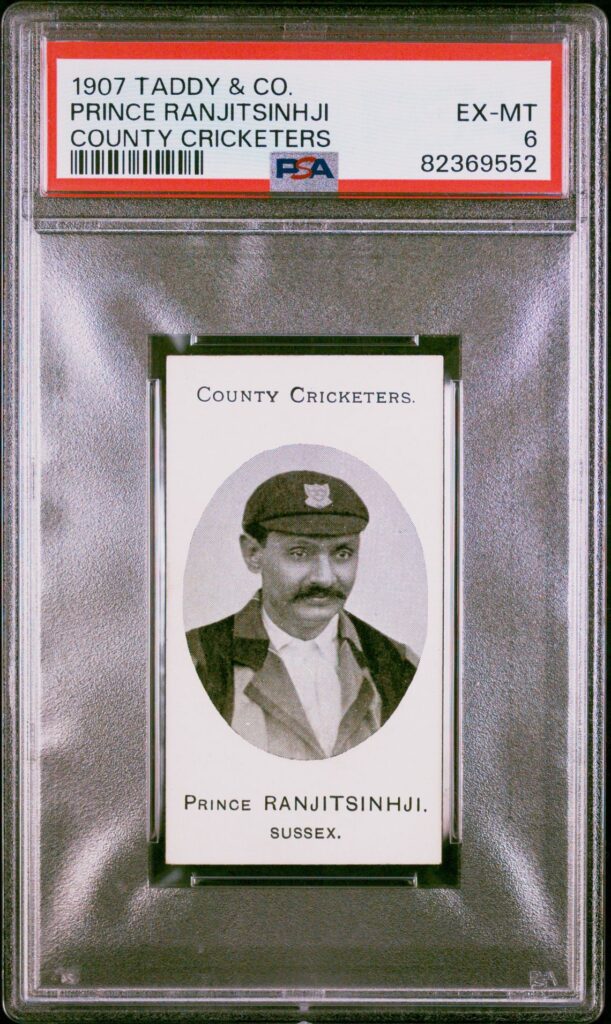
A PSA 6 (EX-MT) tobacco card of cricket’s first global superstar, issued in the year he ascended to the throne of Nawanagar. One of only seven examples graded by PSA.
Cricket’s first global superstar
In the summer of 1896, a battle was being fought in the committee rooms of English cricket that had nothing to do with batting averages.
The MCC’s President, Lord Harris — a former Governor of Bombay — was determined that Kumar Shri Ranjitsinhji would not represent England against the touring Australians. Harris called him a “bird of passage” who would one day return to India. Behind closed doors, the objections were even less diplomatic. The establishment did not want an Indian in an England shirt, and they were not shy about saying so.
The public, who had watched Ranjitsinhji dazzle for Sussex since his debut the previous year, were outraged. But the peculiar selection customs of the era intervened. In those days, the county hosting a Test match had the final say on team selection. When the series moved to Old Trafford for the second Test, Lancashire simply picked him.
What followed was one of the most remarkable debuts in the history of the game.
England were in desperate trouble, forced to follow on 181 runs behind. W.G. Grace fell with the score at just eleven. Ranjitsinhji walked to the crease and, over the course of one hundred and ninety minutes, played an innings that those present would never forget. He was struck on the ear by a bouncer from Ernest Jones, then the fastest bowler in the world. He barely flinched. By the time play broke for lunch, he had reached 154 not out — becoming the first batsman in Test history to score a century before the interval.
The Australian allrounder George Giffen called it the finest innings he had ever witnessed. The Guardian was unequivocal: “No man living has ever seen finer batting than Ranjitsinhji showed in this match. Grace has nothing to teach him as a batsman.”
He was twenty-three years old, and he had changed the game forever.
The man who opened up the leg side
Before Ranjitsinhji, batting in England was an essentially forward, off-side affair. Batsmen pushed and drove; leg-side scoring was considered ungentlemanly, almost accidental. His great friend C.B. Fry recalled being told as a schoolboy that if one hit the ball to the on side, “one apologised to the bowler.”
Ranjitsinhji rewrote those conventions. His extraordinary contribution — arguably the single most important innovation in the history of batting technique — was the leg glance. The story of its invention is wonderfully physical: practising at Cambridge, a professional coach is said to have nailed his back boot to the crease to stop him backing away from fast bowling. With his right foot fixed, Ranjitsinhji found that by moving his left leg across he could flick deliveries off middle stump behind his legs with a turn of the wrists.
It was a shot nobody else could play with such control, and it opened up an entire half of the cricket field that had previously been left fallow. Combined with his mastery of the late cut and an innovative commitment to back-foot play — in an era when the textbooks demanded forward defence — he didn’t just score runs differently. He changed what batting could be.
Neville Cardus, the great cricket writer, put it best: “When Ranji batted, a strange light was seen for the first time on English fields, a light out of the East.”
The numbers confirmed the revolution. In 1896, his first full season, he amassed 2,780 runs with ten centuries, breaking W.G. Grace’s twenty-five-year-old record for the highest aggregate in a season. In 1899 he became the first batsman ever to score 3,000 runs in a season. He repeated the feat in 1900. For Sussex alone, between 1895 and 1920, he scored 18,594 runs at an average of 63.2.
Prince and ruler
Born in 1872 in Sarodar, a small village in western India, Ranjitsinhji’s early life was shaped by the shifting politics of succession. Chosen as heir to the throne of Nawanagar as a child, then cast aside when another claimant emerged, he was sent to England in 1888 at the age of sixteen. He enrolled at Trinity College, Cambridge, where he discovered cricket on Parker’s Piece — the famous town common where undergraduates mixed with local clubs — and began the unlikely journey from unknown Indian student to the most celebrated sportsman in the British Empire.
His cricketing fame ultimately proved decisive in securing the throne that had once been denied to him. In 1907 — the same year this card was issued — Ranjitsinhji succeeded as Jam Sahib of Nawanagar, becoming its Maharaja. It was, by all accounts, a role he took seriously. His administrator, Colonel Berthon, worked with the architect Edwin Lutyens to modernise the capital Jamnagar, improving irrigation, building railways, and transforming what Ranjitsinhji himself had once called an “evil slum” into what became known as the “Jewel of Kathiawar.”
During the First World War, he converted his house in Staines into a convalescent hospital for wounded soldiers and donated troops from Nawanagar to fight for the Allies. In 1915, a shooting accident on a Yorkshire moor cost him his right eye. Despite this, he returned to play three matches for Sussex in 1920 at the age of nearly forty-eight — overweight, one-eyed, and determined to test whether he could still bat. Wisden recorded, with characteristic understatement, that “whatever they had seen in the rotund figure of an Indian prince at the wicket, it had not been Ranji.”
He died of a heart attack in April 1933, aged sixty. His ashes were scattered on the Ganges. Two years later, the Board of Control for Cricket in India inaugurated a new domestic first-class championship in his honour. The Ranji Trophy remains, to this day, the most prestigious domestic cricket competition in India.
The card
This is a tobacco card from the “County Cricketers” series issued by Taddy & Co. of London in 1907. It measures approximately 1.4 × 2.55 inches and features a black-and-white photographic portrait of Ranjitsinhji in his Sussex cap, identified simply as “Prince Ranjitsinhji. Sussex.” beneath the series title “County Cricketers.”
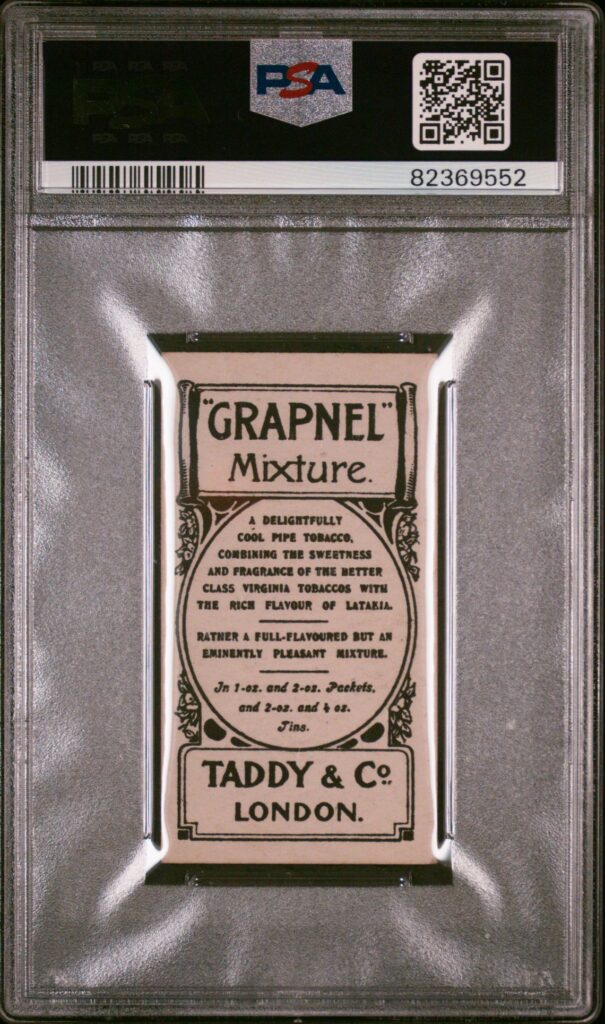
The reverse carries an advertisement for Taddy’s “Grapnel” Mixture pipe tobacco — “A Delightfully Cool Pipe Tobacco, Combining the Sweetness and Fragrance of the Better Class Virginia Tobaccos with the Rich Flavour of Latakia” — a period detail that places the card firmly in its Edwardian context.
This example has been authenticated and graded by PSA as EX-MT 6 (Excellent-Mint), certification number 82369552. The PSA population report for this card currently records just seven graded examples across all grades: a single PSA 7, this PSA 6, a PSA 5, two at PSA 4, a PSA 3, and a PSA 2. Seven cards. That is the entire known graded population of one of the most important cricketers who ever lived, from a set issued nearly 120 years ago by a manufacturer whose company records were destroyed.
As the second-highest graded example — and the only PSA 6 — this card occupies a particularly compelling position for the serious collector: near the summit of the population, yet at a grade that remains attainable where a PSA 7 of this rarity may not surface again for years, if ever.
Taddy & Co., London
James Taddy established his tobacco business in 1784, selling tobacco, snuff, and tea from Old Swan Lane in the City of London. By 1785 he had moved to 109 Fenchurch Street, where a series of marriages between the Taddy, Tomlin, Hatfeild, and Friend families created a tightly interwoven business dynasty. In 1813, the company relocated to purpose-built premises at the Minories, where a factory was constructed for the manufacture of tobacco and snuff.
Taddy’s first set of cigarette cards — “Actresses” — appeared in 1897. The “County Cricketers” series of 1907, comprising some 238 cards, was among their most ambitious issues and remains one of the most sought-after cricket card sets in existence. The company also produced the celebrated “Prominent Footballers” series and the near-legendary “Clowns and Circus Artistes” set, which commands extraordinary prices at auction.
The company’s end is one of the more remarkable stories in British commercial history. Under Gilliat Hatfeild, who inherited the business in 1906, Taddy workers were famously well paid — better, in fact, than the rates the unions would later demand in the industry-wide strike of 1920. When the strike was called, Hatfeild’s employees walked out alongside the rest of the trade, despite already earning above the disputed rate. Hatfeild, who had warned that any strike would result in permanent closure, kept his word. The factory at the Minories was shut. The workforce was dismissed. According to accounts passed down through the family and the Cartophilic Society, Hatfeild burned the company’s records.
Taddy & Co., after 136 years of continuous operation, simply ceased to exist.
That history lends every surviving Taddy card a particular quality of scarcity. These are not cards from a company whose archives were absorbed by a successor or whose stock was remaindered and dispersed. They are remnants of a business that was deliberately and completely erased.
Why this card matters
There are cards that are valuable because they are rare. There are cards that are valuable because of who they depict. Occasionally, a card manages to be both — and to carry, in addition, a story that elevates it beyond the collecting market into something closer to a cultural document.
This is such a card.
It captures Ranjitsinhji at the precise intersection of his two remarkable lives: still recognised as perhaps the greatest batsman of the Golden Age, and newly installed as ruler of his native state. The year of issue — 1907 — marks the moment when the Indian prince who had conquered English cricket returned home to govern.
As one of only seven examples graded by PSA — and the sole PSA 6 — it represents one of the finest known surviving examples of a card from a manufacturer whose records were destroyed over a century ago, depicting a cricketer whose influence on the game remains immeasurable. India’s premier domestic tournament still bears his name. The leg glance — the shot he invented on Parker’s Piece with his boot nailed to the ground — is played on every cricket field in the world, every day.
Neville Cardus once described Ranjitsinhji as “the Midsummer Night’s Dream of cricket.” This small rectangle of Edwardian card, with its oval portrait and its advertisement for pipe tobacco on the reverse, is one of the few physical objects that survive from his playing days — a direct, tangible connection to the man who changed the game.